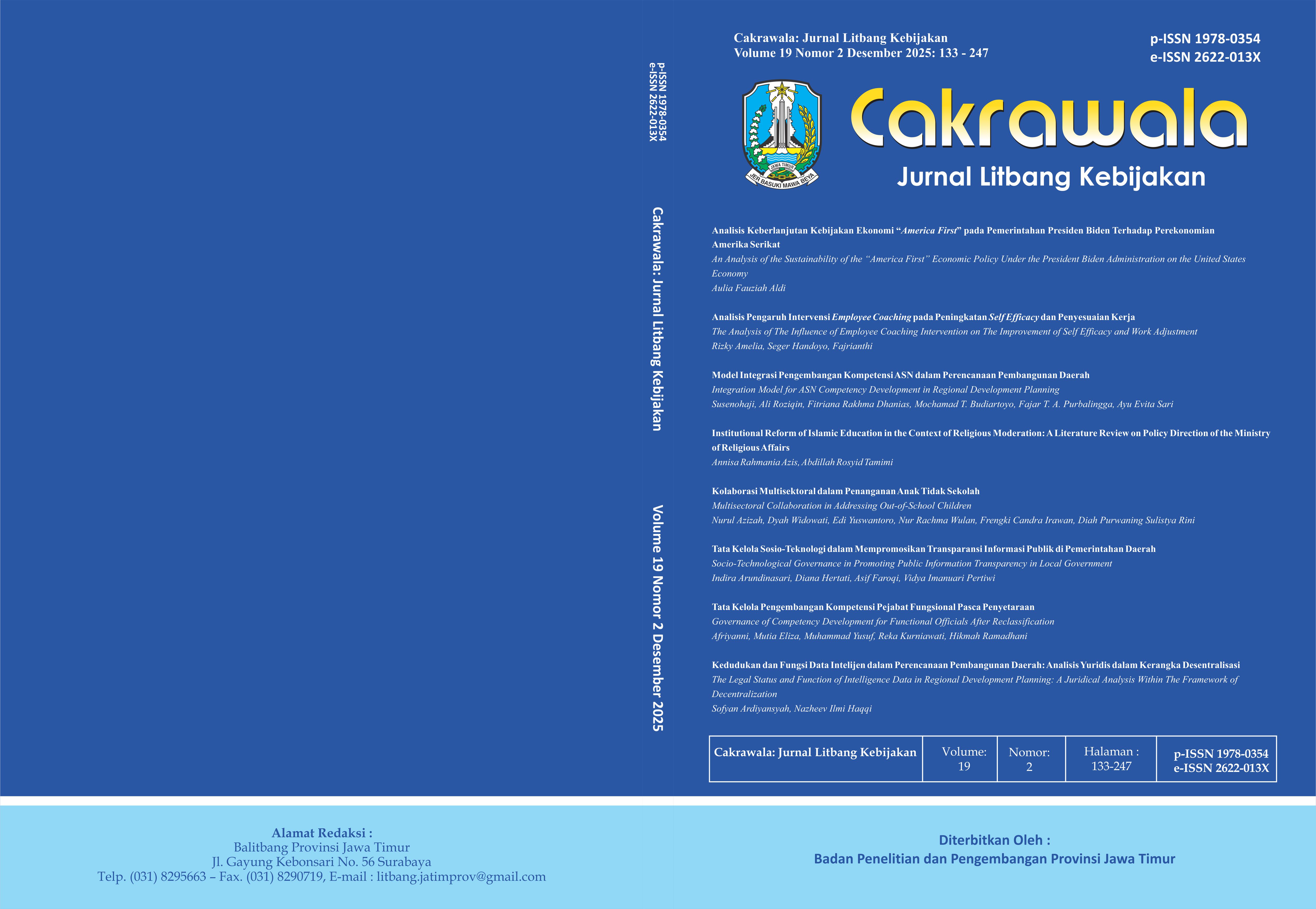
Analisis Pengaruh Intervensi Employee Coaching pada Peningkatan Self Efficacy dan Penyesuaian Kerja
DOI:
https://doi.org/10.32781/cakrawala.v19i2.826Keywords:
Efikasi Diri, Employee Coaching, Penyesuaian KerjaAbstract
Penelitian ini bertujuan untuk menguji dampak intervensi employee coaching terhadap self-efficacy dan penyesuaian kerja alumni IPDN Tahun 2023 Kontingen Jawa Timur. Metode penelitian menggunakan pendekatan kuantitatif dengan desain eksperimen pretest-posttest dengan kelompok kontrol. Kelompok eksperimen yang berjumlah 10 orang yang menerima intervensi coaching menggunakan model GROW, sedangkan kelompok kontrol (10 orang) tidak menerima intervensi. Analisis data dilakukan dengan menggunakan Independent Samples t-Test dan statistik deskriptif. Hasil penelitian menunjukkan bahwa intervensi employee coaching memberikan dampak signifikan dalam meningkatkan self-efficacy dan penyesuaian kerja peserta. Kesimpulan penelitian ini menegaskan pentingnya peran coaching dalam mendukung adaptasi pegawai baru di lingkungan kerja.
References
Bandura, A. (1982). Self-efficacy Mechanism in Human Agency. American Psychologist, 37(2), 122–147.
Bandura, A. (1986). Social Foundations of Thought and Action: A Social Cognitive Theory. Prentice-Hall.
Bozer, G., & Jones, R. J. (2018). Understanding the factors That Determine Workplace Coaching Effectiveness: A Systematic Literature Review. European Journal of Work and Organizational Psychology, 27(3), 342-361.
Corbu, A. I., Opre, A., & Balas-Timar, D. (2021). Positive Psychology Micro-Coaching Intervention Increases Work-Related Psycho-logical Capital. Journal of Rational-Emotive & Cognitive-Behavior Therapy, 39(4), 514-536.
Fodor, M., Jackel, K., & Szilagyi, T. P. (2018). Challenges of Starting a Success Career from The Aspect of the Z generation. In Proceedings of FIKUSZ ’17. Óbuda University, Keleti Faculty of Business and Management.
Francisco, D. J. (2019). The Principal’s Role in Shaping School Culture. International Journal of Educational Leadership and Management, 7(1), 43-63.
Greco, C., Geller, J., & Rauf, A. (2022). How School Leadership can Foster Teachers’ Well-Being: A Systematic Literature Review. Educational Management Admi-nistration & Leadership, 50(5), 749-767.
Honicke, T., Broadbent, J., & Dekeyser, S. (2023). The Cyclical Relationship Between Self-Efficacy and Feedback, and the Role of The Learning Environment: A Longitudinal Path Analysis. Metacognition and Learning, 18, 595–620.
Hwang, M. H., Choi, H. C., Lee, A., & Culver, J. D. (2016). The Relationship Between Self-Efficacy and Academic Achievement: A 5-Year Longitudinal Study. The Asia-Pacific Education Researcher, 25(1), 89-98.
Lorsbach, A. W., & Jinks, J. L. (1999). Self-efficacy Theory and Learning Environment Research. Learning Environments Research, 2(2), 157–167.
Lubbers, R., Loughlin, C., & Zweig, D. (2005). Young Workers’ Job Self-Efficacy and Affect: Pathways to Health and Performance. Journal of Occupational Health Psychology, 10(4), 351–362.
Lysgaard, S. (1955). Adjustment in a Foreign Society: Norwegian Fulbright Grantees Visiting the United States. International Social Science Bulletin, 7(1), 45-51.
Maloni, M., Hiatt, S., & Campbell, S. (2019). Understanding the Work Values of Gen Z Business Students. The International Journal of Management Education, 17(3), 100320.
Na-nan, K., & Sanamthong, E. (2019). Self-efficacy and Employee Job Performance. International Journal of Quality & Reliability Management, 37(1), 1–17.
Neuenschwander, M. P., & Hofmann, V. (2021). How do Apprentices’ and Their Supervisors’ Goal Orientations Affect Apprentices’ Work-Related Well-Being and Their Satisfaction with the Apprenticeship?. Vocations and Learning, 14(1), 105-126.
Pousa, C., & Mathieu, A. (2015). The influence of Coaching on Employee Performance: The Case of a Large Canadian Organization. Journal of Management Development, 34(3), 246-266.
Razak, N. A., Darmawan, I. G. N., & Kee, K. N. (2018). The Relationship Between Coaching and Self-Efficacy. International Journal of Modern Trends in Social Sciences, 1(4), 1-13.
Son, S. (2016). The Impact of Career Support on Employees’ Work Adjustment: The Mediating Role of Career Development. Journal of Career Development, 43(3), 244-258.
Villafañe, S. M., Garcia, C. M., & Lewis, J. E. (2016). Exploring the Role Of Self-Efficacy in the Retention of STEM Students: A Mixed-Methods Study. Chemistry Education Research and Practice, 17(1), 129-145.
Whitmore, J. (1992). Coaching for Performance: GROWing Human Potential and Purpose. Nicholas Brealey Publishing.
Downloads
Published
How to Cite
Issue
Section
Citation Check
License
Copyright (c) 2025 Rizky Amelia, Seger Handoyo, Fajrianthi

This work is licensed under a Creative Commons Attribution 4.0 International License.